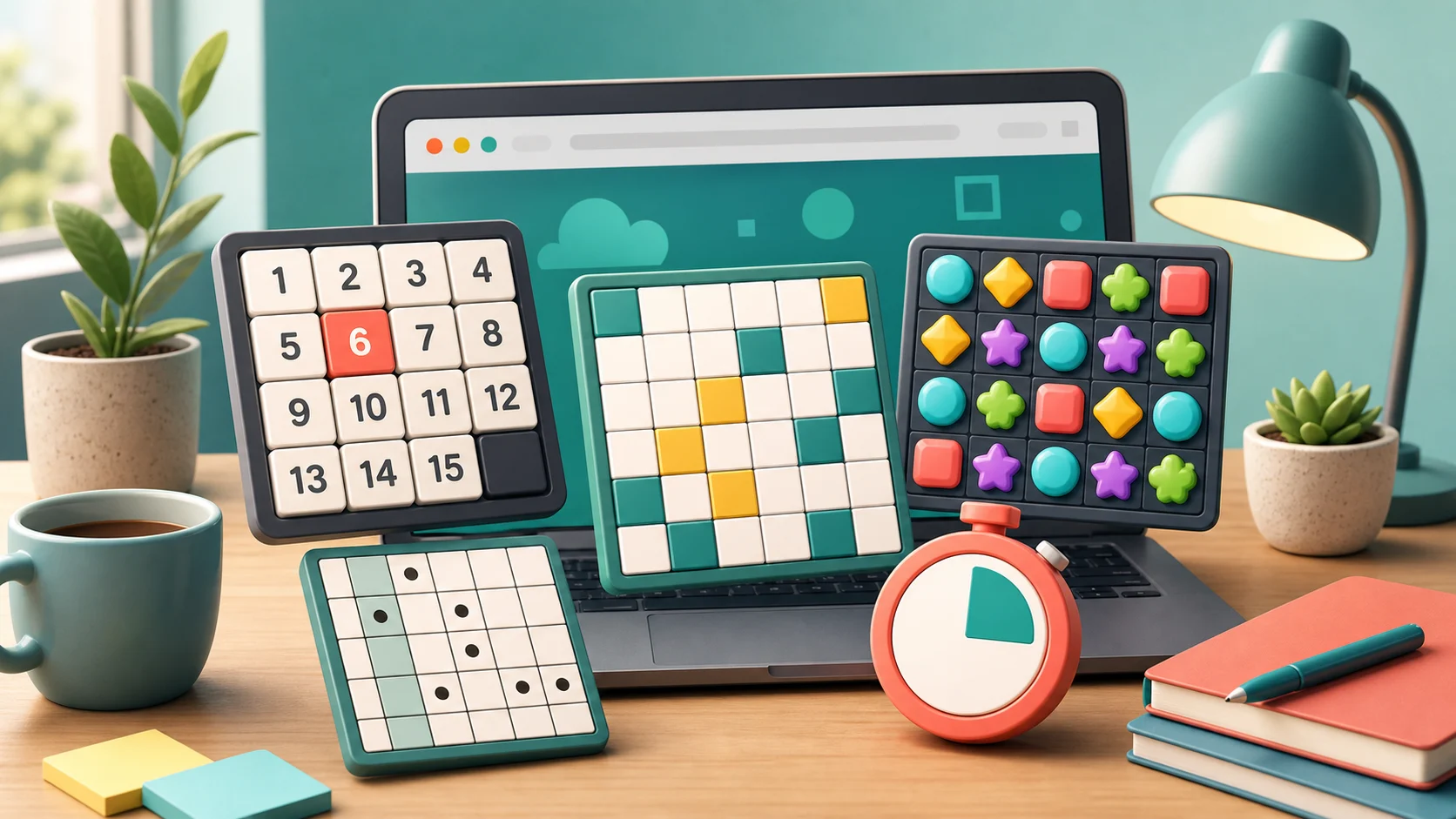
The quickest puzzle is not always the smallest one. A quick puzzle is the one that fits your available attention. Two minutes can handle a score loop. Ten quiet minutes can handle a board that needs memory, notes, or route planning.
If You Have Two To Five Minutes
Start with 2048, Block Puzzle, Word Search, or Garden Color Stacks. These games give you a readable first move and quick feedback. You can play one short run without feeling like you abandoned a long solve.
Bubble Shooter also works in this window if you want a puzzle with aim. Choose it when you want one shot at a time rather than a full grid of clues.
If You Have Five To Ten Minutes
Move to Minesweeper, Mahjong Solitaire, Connect the Dots, or Jigsaw Puzzle. These boards still start quickly, but they benefit from a little continuity.
This is the sweet spot for learning one habit: flag only proven mines, clear free tile pairs that open layers, route edge pairs first, or place jigsaw edges before middle pieces.
If You Have A Quiet Stretch
Use Sudoku, Nonogram, or Crossword when you can hold context. These puzzles reward notes, crossings, and line logic. They are not necessarily hard, but they become better when you are not constantly interrupted.
Some active progress or best results may save on the same device where supported. Treat that as a local browser convenience.
Choose Your Next Puzzle
Two minutes: 2048 or Block Puzzle. Five minutes: Minesweeper or Mahjong Solitaire. Ten or more: Sudoku, Nonogram, or Crossword. If you care more about mechanic than time, use Match, Sort, Or Clear to choose by first move.