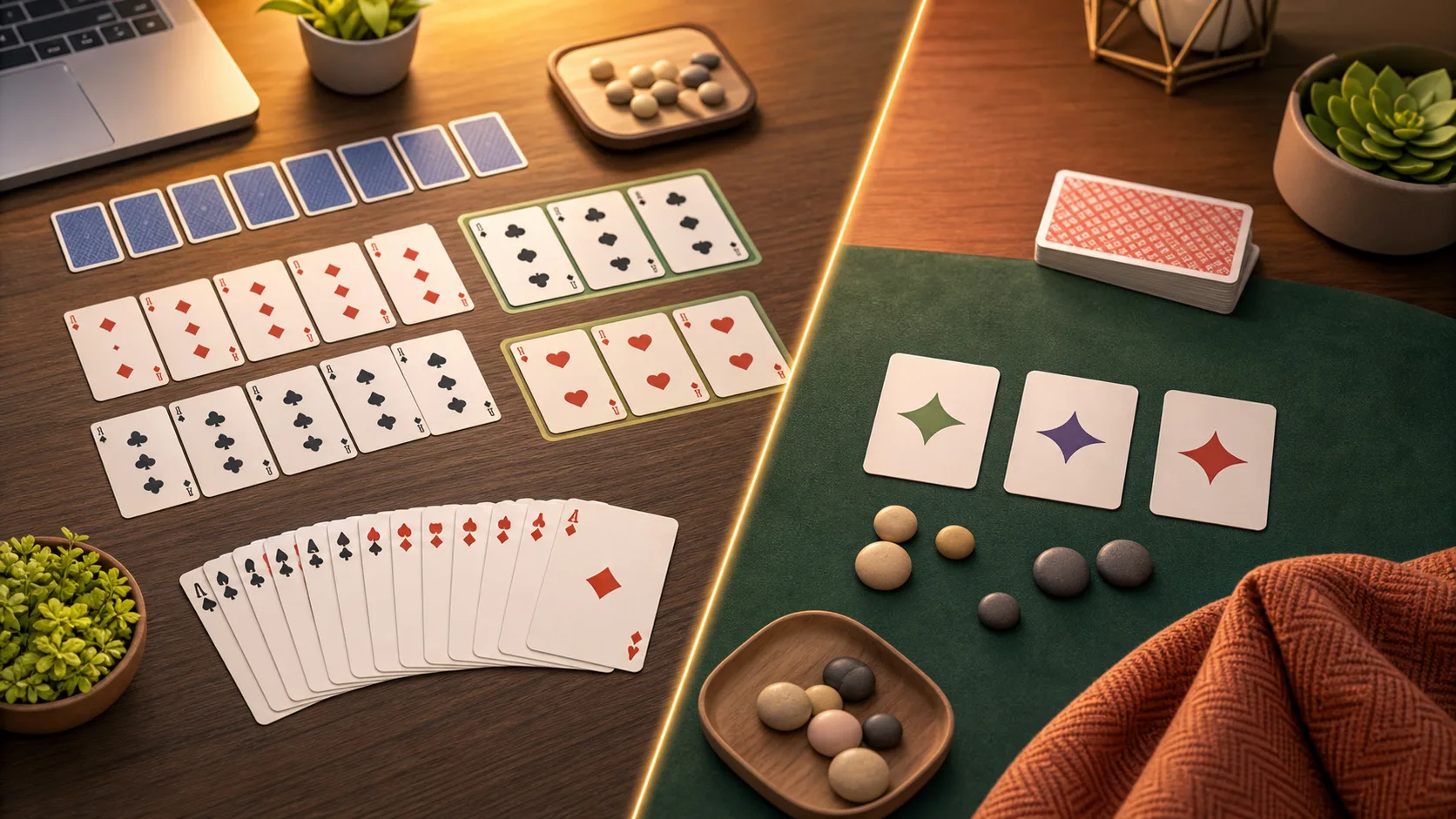
Rummy and Teen Patti both sit in Poket52’s card table lineup, but they are not asking for the same kind of attention. Rummy gives you a 13-card hand to arrange into sets and sequences. Teen Patti gives you three cards, asks you to name the pattern, then compares that hand with a local challenge hand.
That makes the choice fairly simple: pick Rummy when you want a slower sorting puzzle, and pick Teen Patti when you want a short pattern-read round. Both open in the browser with no download or sign-up, but the first move feels different enough that it is worth choosing before you start.
Start With The Hand Size
Rummy is the better fit when you want a card puzzle with room to rearrange. The Poket52 version starts from a 13-card hand. A set needs three or four cards of the same rank in different suits, and a sequence needs three or more neighboring ranks in one suit.
The work is not just spotting one good group. You draw from the stock or take the discard top, decide what still belongs in your hand, and discard before drawing again. Submit only makes sense after all 13 cards are laid into valid groups, including at least one set and one sequence.
That larger hand gives Rummy a more deliberate feel. You can sort, select cards, return a group if it was not helping, and keep working toward a cleaner finish. Poket52 also saves your best local score on the same device, so it suits repeat attempts where you want one hand to go a little better than the last.
Teen Patti is much tighter. You reveal three local cards, sort them if the ranks are easier to read high to low, then choose the pattern that matches the hand. The pattern ladder on the page runs from High Card and Pair up through Same Suit, Run, Same-Suit Run, and Trio.
Because there are only three cards, the decision arrives quickly. The useful question is not “how do I reshape this hand?” It is “what am I actually looking at?” Once the pattern is correct, you compare it with the challenge hand and start another round when ready.
Rummy Or Teen Patti By Break Length
Choose Rummy if you have enough time to hold a few possible groups in your head. A promising same-suit sequence might need one more card from the stock. A set might be nearly ready, but only if you stop carrying a loose card that blocks the next discard. The round rewards patience because every draw changes what the best grouping could be.
Choose Teen Patti if you want a small decision that resolves fast. Reveal all three cards first, sort when the order looks messy, then match the hand to the ladder. It is a good first pick when you want a card game that feels complete without managing a long tableau.
The difference is also useful on smaller screens. Rummy has more cards and more table state to watch: hand, stock, discard, laid groups, and submit readiness. Teen Patti has fewer moving parts, so the core read stays compact.
What To Watch In Rummy
The first useful Rummy habit is to separate real groups from almost-groups. Three neighboring cards in the same suit can become a sequence. Three matching ranks in different suits can become a set. Two cards that only look related are not enough unless the next draw or discard top actually turns them into something valid.
Use the discard pile with intent. Taking the discard top is good when it completes a set or sequence, but it can also make the hand heavier if you do not know what you will drop next. Drawing from the stock is cleaner when the current discard does not help an obvious group.
Before submitting, read the whole hand instead of only the last group you made. Poket52 Rummy needs all 13 cards grouped, not just one attractive meld. If one card is still loose, the hand is not finished.
What To Watch In Teen Patti
Teen Patti rewards naming the pattern before thinking about the comparison. Open all three cards, then ask the simplest question first: are all three ranks the same? If yes, it is Trio. If not, check whether the cards form neighboring ranks. If they do, suit decides whether it is Same-Suit Run or Run.
If the ranks do not run together, look for a Pair. If there is no pair, check whether all three cards share a suit. If none of those patterns fit, you are down to High Card.
That order keeps the round clean. It also prevents the most common mistake: seeing one attractive suit match and ignoring that the hand might rank higher as a run or pair. The page’s pattern choices are visible, so use them like a ladder rather than guessing from memory.
Where The Other Card Games Fit
If neither card-pattern game sounds right, the Card & Board category has slower table options. Solitaire, Spider Solitaire, and FreeCell are better when you want classic solitaire-style movement instead of pattern naming.
Palette Duel is another nearby option if you like managing a hand against a table card. It asks you to match hue, number, or symbol, so it has more back-and-forth pressure than Teen Patti but less 13-card sorting than Rummy.
For a deeper comparison of the solitaire-style tables, read Solitaire, Spider Solitaire, Or FreeCell. For the broader table lineup, the card and board games overview is the better next stop.
The Simple Pick
Play Rummy when you want to sort a full hand, plan sets and sequences, and work toward a complete 13-card finish. Play Teen Patti when you want a fast three-card pattern read with a clear compare step.
Both choices are free browser card games on Poket52, but the better first pick depends on the break you actually want. Rummy gives you more to organize. Teen Patti gives you a quicker answer.